Search results for tag #fediverse
![[?]](https://cdn.masto.host/privacysafesocial/accounts/avatars/113/321/356/097/972/735/original/7b12c0b878d8e022.jpg)
🛡️ #Cybersecurity news & tips across the #fediverse
“Somerville, Massachusetts residents take note: one of the agenda items for tonight's city council is an ordinance on use of ⌗ArtificialIntelligence for ⌗policing and hiring decisions:
somervillema․legistar․com…”
https://better.boston/@athorn/117484935475796876
🤖 via RSS feed. Not an endorsement.
🛡️ #Cybersecurity news & tips across the #fediverse
“Surveillance Daily: October 22, 2026 ⌗ALPR ⌗Surveillance ⌗Privacy ⌗FlockSafety deflocktheusa․com/surveillance-daily-october-22-2026/”
https://mastodon.social/@deflocktheusa/117484881148910971
🤖 via RSS feed. Not an endorsement.
![[?]](https://cdn.masto.host/privacysafesocial/accounts/avatars/113/727/590/226/767/771/original/43b84e1017f05e04.png)
🔬 The best bytes of #science & #tech across the #fediverse
“Oil tanker rates from Middle East to Asia increases fivefoldMOSCOW: Oil tanker rates from the Persian Gulf to Asia on large tankers have increased fivefold compared to…
⌗EuropeSays ⌗Headlines ⌗News ⌗Europe…”
https://pubeurope.com/@europesays/117482718887632099
🤖 via RSS feed. Not an endorsement.
![[?]](https://virmasto.hel1.your-objectstorage.com/accounts/avatars/117/120/275/729/476/066/original/27c5e5e14d156166.png?1791190830)
Наконец завершили новое обновление VIR.GROUP 🚀
Оно уже отправлено на проверку в Google Play и App Store. Ждём одобрения, потому что обновление важное для всех участников платформы.
Что нового:
Улучшена производительность.
Персональные уведомления о постах участников.
Новая функция: кошелёк с VIR credits. Через него можно получать бонусы, приобрести премиум аккаунт и продвигать свои проекты на топовые позиции, чтобы получать больше просмотров.
Улучшенный личный мессенджер.
Новый дизайн личных и публичных профилей.
Обновлённая версия виртуального помощника и многое другое.
Спасибо всем, кто пользуется платформой и делится обратной связью. Как только магазины одобрят обновление, оно появится в вашем приложении 🤝
#VIRGROUP #Startups #Entrepreneurship #Investing #ProductUpdate #Fediverse #Founders #Investors

![[?]](https://dresden.s3proxy.de/accounts/avatars/115/475/380/537/211/634/original/4671957927283184.jpg)
Liebes #Fediverse
oft ist von Unternehmen, Künstlern und sogar Vereinen zu lesen, dass #Mastodon & Co sich nicht lohnen und man deshalb auf den #Plattformen von #BigTech bleiben müsse, um online die erforderlich Reichweite zu bekommen, um seinen #SocialMedia-Auftritt auch wirtschaftlich erfolgreich zu gestalten.
Ob das mit der Reichweite bei #Instagram #LinkedIn & Co überhaupt stimmt, wissen wir nicht genau. Das könnt Ihr besser bei Menschen mit entsprechender Expertise wie
https://digitalcourage.de/blog/2025/die-reichweitenluege
oder @ueckueck
https://media.ccc.de/v/froscon2026-3620-der_reichweitenmythos_debunked#t=217
nachlesen bzw. anschauen.
Was wir aber sagen können: 262 Follower und etwas Herzblut für die Sache genügen, um aus der hiesigen Community als #Steuerberater und #Rechtsanwalt angefragt zu werden!
#Danke für dieses tolle Feedback!
Wenn Ihr also mal wieder über den wirtschaftlichen Nutzen des Fediverse mit einem Skeptiker diskutieren müsst, dürft Ihr uns gern als Gegenbeispiel anführen.
RE: https://dresden.network/@Obermueller_und_Partner/117117367290901845
Aus aktuellem Anlass von weiteren Anfragen aus dem #Fediverse möchten wir nochmal alle #Unternehmen ermutigen, sich nicht auf die #SocialMedia #Plattformen von #BigTech zu versteifen!
Seid authentisch, seid an den Menschen interessiert und Ihr werdet Erfolg haben!
Und wirklich schön dabei ist auch, dass Ihr dann bei #Mastodon & Co nicht nur neue Kunden, Patienten oder Mandanten bekommt, sondern auch spannendes Feedback, echte Hilfe und kreative Ideen aus der Community!
Einmal mehr #Danke!
Liebes #Fediverse
oft ist von Unternehmen, Künstlern und sogar Vereinen zu lesen, dass #Mastodon & Co sich nicht lohnen und man deshalb auf den #Plattformen von #BigTech bleiben müsse, um online die erforderlich Reichweite zu bekommen, um seinen #SocialMedia-Auftritt auch wirtschaftlich erfolgreich zu gestalten.
Ob das mit der Reichweite bei #Instagram #LinkedIn & Co überhaupt stimmt, wissen wir nicht genau. Das könnt Ihr besser bei Menschen mit entsprechender Expertise wie
https://digitalcourage.de/blog/2025/die-reichweitenluege
oder @ueckueck
https://media.ccc.de/v/froscon2026-3620-der_reichweitenmythos_debunked#t=217
nachlesen bzw. anschauen.
Was wir aber sagen können: 262 Follower und etwas Herzblut für die Sache genügen, um aus der hiesigen Community als #Steuerberater und #Rechtsanwalt angefragt zu werden!
#Danke für dieses tolle Feedback!
Wenn Ihr also mal wieder über den wirtschaftlichen Nutzen des Fediverse mit einem Skeptiker diskutieren müsst, dürft Ihr uns gern als Gegenbeispiel anführen.
🔬 The best bytes of #science & #tech across the #fediverse
“OpenAI CLI
Link: github․com/openai/openai-cli
Comments: news․ycombinator․com/item?id=50191507”
https://framapiaf.org/@newsycombinator/117483270080005805
🤖 via RSS feed. Not an endorsement.
🛡️ #Cybersecurity news & tips across the #fediverse
“Who Checks the Checkers? Alexandria’s ALPR Audit Gap ⌗ALPR ⌗Surveillance ⌗Privacy ⌗FlockSafety deflocktheusa․com/who-checks-the-checkers-alexandrias-alpr-audit-gap/”
https://mastodon.social/@deflocktheusa/117484881089908617
🤖 via RSS feed. Not an endorsement.
🔬 The best bytes of #science & #tech across the #fediverse
“Well, a cup of hot coffee ☕ and an avalanche of 'merge window'․․․:) ⌗life ⌗coffee ⌗music ⌗linux ⌗research”
https://mastodon.social/@unixbhaskar/117481152466482826
🤖 via RSS feed. Not an endorsement.
![[?]](https://cdn.masto.host/tootfedilabapp/accounts/avatars/000/037/425/original/9eed6ecefabe8113.png)
Concerning #HolosSocial, I still believe it's an interesting project because it brought something new to the #Fediverse.
Not only because you run your #ActivityPub server on your device, but mainly because you can own your identity with your own domain name.
My mistake was making it easy to run the server on your device, but not to get your own identity.
That will be my challenge in the coming months.
PS: I have no funding for this project and I work alone, so yes, it takes time :)
🔬 The best bytes of #science & #tech across the #fediverse
“🐧 NEW: Researchers with ⌗NewZealand ’s volunteer-run ⌗Tawaki Project mapped 1,200 ⌗Fiordland crested ⌗penguin nests across nine ⌗fjords over twelve years, finding a population roughly three times lar…”
https://fediscience.org/@tksst/117481026485128472
🤖 via RSS feed. Not an endorsement.
🛡️ #Cybersecurity news & tips across the #fediverse
“💥 DISBAND NATO💥 ABOLISH THE BBC💥 GLOBALISE THE INTIFADA💥 BURN THE MEANS OF SURVEILLANCE💥 ERADICATE ZIONISM🦋 HEAL THE PLANET--- ⌗france ⌗capitalism ⌗surveillance ⌗resistance ⌗zionism ⌗freepales…”
https://mastodon.world/@rzeta0/117483870957844812
🤖 via RSS feed. Not an endorsement.
![[?]](https://cdn.masto.host/privacysafesocial/accounts/avatars/113/580/921/793/249/556/original/ae3cb7f30b5094d5.png)
🔆 #FediTips for https://PrivacySafe.Social & the #fediverse
“If you have any questions about using Mastodon or the wider Fediverse, please post them in the replies and I'll try to find you some answers․It would be especially nice to hear from new people and people who aren't conf…”
https://social.growyourown.services/@FediTips/117485452414465194
🤖 via RSS feed. Your Mileage May Vary.
![[?]](https://media.muenchen.social/muc/accounts/avatars/000/000/001/original/25ff3ded94a90191.png)

A crawler wanted to know who talks to whom on our server
For two weeks, a client from China's state-run academic network queried our Mastodon instance for who follows whom. Not content — relationships. No project description exists anywhere. Here is what we found, and how to check your own instance.
Ein Crawler wollte wissen, wer bei uns mit wem in Kontakt steht
Zwei Wochen lang hat ein Client aus Chinas staatlichem Wissenschaftsnetz auf troet.cafe abgefragt, wer wem folgt. Nicht Inhalte, sondern Beziehungen. Eine Projektbeschreibung dazu ist nirgends auffindbar. Wir haben es unterbunden und legen die Zahlen offen.
![[?]](https://s3.eu-central-2.wasabisys.com/mastodonworld/accounts/avatars/116/564/572/406/051/112/original/0a8e0c58b286c349.png)
Adding #sketching / #drawing from late last night to #fediverse and #inktober

Alt...
A monochromatic abstract drawing featuring chaotic, overlapping lines that create a dynamic, textured composition, suggesting figures or forms in a distorted style. The bottom corner has the name “NOY”
🛡️ #Cybersecurity news & tips across the #fediverse
“New Mexico judge orders Meta to pay $25 billion for misleading users about data privacyA jury found that Meta made dozens of false or misleading statements about how Facebook handled user data and content moderation․ Th…”
https://mastox.eu/@Sans_Google/117483338856050511
🤖 via RSS feed. Not an endorsement.
🔬 The best bytes of #science & #tech across the #fediverse
“⌗MissKitty had run prior ⌗research so didn't take much to pull out subset of information to explain some very important ⌗benefits of demanding ⌗solar ⌗data ⌗centers․ They are possible right now․ 20 y…”
https://bsky.brid.gy/r/https://bsky.app/profile/did:plc:hc7tndm7gduompba65aps75k/post/3myg3rt4mm225
🤖 via RSS feed. Not an endorsement.
![[?]](https://cdn.masto.host/socialgrowyourownservices/accounts/avatars/111/589/347/315/890/061/original/e603733b53591171.png)
If you have any questions about using Mastodon or the wider Fediverse, please post them in the replies and I'll try to find you some answers.
It would be especially nice to hear from new people and people who aren't confident about technical matters. There is absolutely no such thing as a silly question! 🙂
![[?]](https://assets.oldbytes.space/assets.oldbytes.space/accounts/avatars/108/194/429/158/116/939/original/5e481bff3e4a5784.png)
I'm curious: is there anybody here on the #fediverse who was involved in #development of the #bbs #software #rbbs for #cpm80 back in the 1980s?
🛡️ #Cybersecurity news & tips across the #fediverse
“Meta’s Muse AI agent leaked thousands of private conversationsSecurity researchers at Claroc found more than 6,800 shared Muse conversation links publicly discoverable through DNS records․The exposed chats included sens…”
https://mastox.eu/@Sans_Google/117483039832191936
🤖 via RSS feed. Not an endorsement.
🔬 The best bytes of #science & #tech across the #fediverse
“Publishers press Brussels and London to stop Meta’s new AI terms politico․eu/article/publishers-press-brussels-and-london-to-stop-metas-new-ai-terms/?utm_source=RSS_Feed&utm_medium=RSS&utm_campaign=RSS_Syndication …”
https://social.espeweb.net/objects/800b4628-c0ce-489b-bd0c-e3ab3a42fb8f
🤖 via RSS feed. Not an endorsement.
🔬 The best bytes of #science & #tech across the #fediverse
“There isn't an easy exploit for this PHP vulnerability
Link: eliastaylor․com/noexploit/
Comments: news․ycombinator․com/item?id=50188948”
https://framapiaf.org/@newsycombinator/117481854505789982
🤖 via RSS feed. Not an endorsement.
![[?]](https://cdn.masto.host/privacysafesocial/accounts/avatars/117/201/444/920/393/725/original/9f3a913d4c8cda41.jpg)
ADELAJAs - SUBJECT INDEXES- "BLOOD - FLESH - SPIRIT - SOUL - MACHINE"
#ADELAJAsCATALOGUEsCONSCIOUSNESS
gabUPDATESaccess
mastodon #FEDIVERSE
veroTABLEBASEaccess
-------
INDEX
-------
#africa
#alternativenews
#breaking
#community
#daily
#democracy
#worldpolitics
ADELAJA'S - "COMMERCIAL INFO SPACE"
https://vero.co/firstcivilization/F3r-GTdv7VN9PL47WBWQq4dm
ADELAJA'S - "GLOBAL EMPORIUM & WORLD BAZAAR"
https://pin.it/15P9AxisT
Copyright 2026 Oladipo Adegboyega Adelaja All rights reserved.

![[?]](https://s3-eu-west-2.amazonaws.com/newsmast/accounts/avatars/110/666/864/999/145/616/original/5cb9bb0835576965.png)
This time next week, @michael and @mariana_b will be in Barcelona for MozFest!
This year's @@mozilla Festival theme is 'Wilding', presenting an opportunity for conversations around decentralisation and the natural growth of the social internet.
If you're there, let us know and let's meet up!
#MozFest #SocialWeb #Fediverse

Alt...
An image of the Barcelona skyline in the background, with framed images of a man in glasses and a woman with long hair in the foreground.
Text reads: MozFest. 28-30 October. Barcelona, Spain. Michael Foster, Director & Co-Founder. Mariana Borges, Project Co-ordinator.
🔬 The best bytes of #science & #tech across the #fediverse
“Scientists Finally Uncover Why Statins Can Cause Muscle Pain in Some Patients sciencedaily․com/releases/2026/10/261019093447․htm ⌗wellness ⌗research ⌗heart -health”
https://flipboard.social/@fedifind/117478125068013409
🤖 via RSS feed. Not an endorsement.
🛡️ #Cybersecurity news & tips across the #fediverse
“'To provide the most detailed accounting to date of unauthorized access, including two incidents that have not been previously reported, The Post interviewed police or city officials in eight states and three former Flo…”
https://tldr.nettime.org/@remixtures/117481771910432697
🤖 via RSS feed. Not an endorsement.
![[?]](https://cdn2.miau.pub/accounts/avatars/116/789/814/625/970/174/original/e70860c4f70bb9ab.jpeg) Acey(she/her)🩷💜💙🏳️⚧️🏳️🌈 [She when I'm femme/He when I'm masc/they any time] » 🌐
Acey(she/her)🩷💜💙🏳️⚧️🏳️🌈 [She when I'm femme/He when I'm masc/they any time] » 🌐
@aceofcosmicspace@lgbtqia.space
HELP! PLEASE BOOST URGENTLY FOR ME! I don't believe it, just when I think I'm making headway, the bank has done it to me again-been slow to take out payments and as a result I'm overdrawn🥺 I'll be charged a fee for this, and it means I can't get groceries or pay bills. As someone who's under the poverty line and disabled, this is obviously extremely frustrating and stressful, and has a knock on effect on my chronic illness and disabilities. I'm trying my hardest but I am stuck. If you could help me clear the overdraft and fees it would be so much appreciated. My goal is $145.00 to get clear. Thank you so much💖
#help #gratitude #disabled #disability #chronicillness #chronicpain #fibromyalgia #ptsd #cptsd #witch #catlover #chronicfatigue #hope #smalljoys #lgbtqia #trans #bisexual #transmutualaid #MutualAidRequest #mutualaidspace #disabledmutualaid #cats #disabledcrowdfund #anxiety #depression #queer #poverty #povertykills #MutualAidSavesLives #halloween #attitudeofgratitude #fedifriends #fediverse #mastodon #community #communityaid #aid #struggle #determined #resilient #tired
#adelajas ADELAJAs - SUBJECT INDEXES - "THE SCIENCE OF ABSTRACT CONSCIOUSNESS" - THE META&METIC" (MAM) (METAAMETIC)
#INFINITE
----------
gabUPDATESaccess
mastodon #FEDIVERSE access
veroTABLEBASEaccess
--------
DESCRIPTIONS OF THE INFINITE
--------
ADELAJA'S - "COMMERCIAL INFO SPACE"
https://vero.co/firstcivilization/F3r-GTdv7VN9PL47WBWQq4dm
ADELAJA'S - "GLOBAL EMPORIUM & WORLD BAZAAR"
https://pin.it/15P9AxisT
Copyright 2026 Oladipo Adegboyega Adelaja All rights reserved.

🔬 The best bytes of #science & #tech across the #fediverse
“europesays․com/us/1133991/ ARS-WSU Open New Research Facility and Diesel Supplies Remain Tight ⌗AG ⌗agriculture ⌗Bioscience ⌗building ⌗chain ⌗consortium ⌗could ⌗cyberattacks ⌗cybersec…”
https://pubeurope.com/@us/117477707988468593
🤖 via RSS feed. Not an endorsement.
🛡️ #Cybersecurity news & tips across the #fediverse
“'A federal intelligence center warned police that city council meetings about Flock 'may be viewed by extremists as a desirable target,' and told them to be on the lookout for 'emotional confrontations․''
——————————————…”
https://archive.harmscommitted.com/@admin/117481737058882922
🤖 via RSS feed. Not an endorsement.
![[?]](https://media.burningboard.net/accounts/avatars/115/674/483/682/152/158/original/0a7f6d2efa21b05c.png)
Das könnte möglicherweise andere Instanzen auch betreffen. Und nicht nur Friendica sondern das ganze Fediverse.
https://anonsys.net/display/bf69967c-866a-d9b9-2414-476080668005
#fediadmin #mastoadmin #fediverse #friendica #mastodon
AodeRelay boostedHallo Fedinauten hier auf anonsys.net,
seit dem letzten Wochenende hatte unsere Friendica-Instanz immer wieder Probleme mit der Erreichbarkeit. Genauer gesagt kam es zu Timeouts, sowohl beim Aufruf der Weboberfläche als auch bei der Nutzung von Apps. Zunächst hatte ich die üblichen Verdächtigen wie die Datenbank, PHP-FPM oder Redis im Verdacht. Die Ursache lag allerdings ganz woanders.
Beim Durchforsten der Apache-Logdateien ist mir der User-Agent YisouSpider aufgefallen, der offenbar sehr häufig auf unsere Instanz zugegriffen hat. Da mir das etwas spanisch vorkam, habe ich die Analyse in diese Richtung vertieft. Die Ergebnisse haben mich angesichts der Zahlen und der möglichen Auswirkungen durchaus überrascht.
So wurde beispielsweise gestern zu einem bestimmten Zeitpunkt eine außergewöhnlich hohe Anfragespitze dieses User-Agents festgestellt. Innerhalb von nur zwei Minuten wurden 5.352 Anfragen von 1.253 unterschiedlichen IP-Adressen protokolliert. Das entsprach rund 97 % aller HTTP-Anfragen in diesem Zeitraum. Die Anfragen betrafen unterschiedliche Ressourcen und wurden zunächst mit HTTP 200 beantwortet. Zeitlich fielen sie mit den Erreichbarkeitsproblemen von anonsys.net zusammen.
Ein Vergleich der Zeiträume hat gezeigt, dass dieser Spider seit dem letzten Wochenende stündlich, teilweise sogar mehrfach pro Stunde, mit einer derart hohen Anzahl an Anfragen auf anonsys.net zugegriffen hat. Dies hat zu einer wiederkehrenden Überlastung des Systems geführt.
Nach der Aktivierung einer Apache-Sperre gestern um 10:48 Uhr wurde der User-Agent bei einem lokalen Test mit HTTP 403 abgewiesen. Die anschließende Überwachung der Logdateien zeigt, dass dieser Spider seitdem keine erfolgreichen Zugriffe mehr auf unsere Instanz verzeichnet hat. Reguläre Zugriffe funktionierten weiterhin. Seit dieser Maßnahme wurden keine weiteren Ausfälle oder Timeouts festgestellt.
Die Ergebnisse zeigen, dass die ungewöhnlich hohe Anzahl an Crawler-Anfragen die Überlastung verursacht hat. Damit hatte der Spider offenbar direkten Einfluss auf die Erreichbarkeit unserer Instanz und die Abarbeitung der Hintergrundprozesse (Worker).
Der Spider wurde also gestern am späten Vormittag gezielt blockiert. Seitdem sind keine weiteren Timeouts aufgetreten, und auch das Monitoring zeigt wieder einen normalen Betrieb an.
Allerdings hat die Überlastung auch die Kommunikation mit anderen Instanzen beeinträchtigt. Nachdem anonsys.net wieder normal lief, hatte sich in der Worker-Warteschlange ein Rückstau von über 90.000 Jobs angesammelt. Davon konnten inzwischen bereits einige tausen Jobs abgearbeitet werden, so das "nur" noch ca 36.000 Jobs offen sind die noch zum abarbeiten sind.
Falls ihr also Beiträge erstellt habt, die noch nicht ausgeliefert wurden, oder euch in eurer Timeline Beiträge angezeigt werden, die schon etwas älter sind, liegt das vermutlich an diesem Rückstau. Die Worker-Warteschlange wird weiterhin kontinuierlich abgearbeitet. Wir brauchen also noch etwas Geduld, bis sich alles wieder normalisiert hat.
Ich werde unsere Instanz weiterhin im Blick behalten. Bitte entschuldigt diese Unannehmlichkeiten.
P. S.: Es lag übrigens nicht an der gestern bekannt gewordenen php2Shel-Sicherheitslücke. 😉
Location: Matrix
![[?]](https://anonsys.net/photo/profile/tux.png?ts=1605883092)
RE: https://anonsys.net/display/bf69967c-866a-d9b9-2414-476080668005
Das könnte möglicherweise andere Instanzen auch betreffen. Und nicht nur Friendica sondern das ganze Fediverse.
#fediadmin #mastoadmin #fediverse #friendica #mastodon
AodeRelay boostedHallo Fedinauten hier auf anonsys.net,
seit dem letzten Wochenende hatte unsere Friendica-Instanz immer wieder Probleme mit der Erreichbarkeit. Genauer gesagt kam es zu Timeouts, sowohl beim Aufruf der Weboberfläche als auch bei der Nutzung von Apps. Zunächst hatte ich die üblichen Verdächtigen wie die Datenbank, PHP-FPM oder Redis im Verdacht. Die Ursache lag allerdings ganz woanders.
Beim Durchforsten der Apache-Logdateien ist mir der User-Agent YisouSpider aufgefallen, der offenbar sehr häufig auf unsere Instanz zugegriffen hat. Da mir das etwas spanisch vorkam, habe ich die Analyse in diese Richtung vertieft. Die Ergebnisse haben mich angesichts der Zahlen und der möglichen Auswirkungen durchaus überrascht.
So wurde beispielsweise gestern zu einem bestimmten Zeitpunkt eine außergewöhnlich hohe Anfragespitze dieses User-Agents festgestellt. Innerhalb von nur zwei Minuten wurden 5.352 Anfragen von 1.253 unterschiedlichen IP-Adressen protokolliert. Das entsprach rund 97 % aller HTTP-Anfragen in diesem Zeitraum. Die Anfragen betrafen unterschiedliche Ressourcen und wurden zunächst mit HTTP 200 beantwortet. Zeitlich fielen sie mit den Erreichbarkeitsproblemen von anonsys.net zusammen.
Ein Vergleich der Zeiträume hat gezeigt, dass dieser Spider seit dem letzten Wochenende stündlich, teilweise sogar mehrfach pro Stunde, mit einer derart hohen Anzahl an Anfragen auf anonsys.net zugegriffen hat. Dies hat zu einer wiederkehrenden Überlastung des Systems geführt.
Nach der Aktivierung einer Apache-Sperre gestern um 10:48 Uhr wurde der User-Agent bei einem lokalen Test mit HTTP 403 abgewiesen. Die anschließende Überwachung der Logdateien zeigt, dass dieser Spider seitdem keine erfolgreichen Zugriffe mehr auf unsere Instanz verzeichnet hat. Reguläre Zugriffe funktionierten weiterhin. Seit dieser Maßnahme wurden keine weiteren Ausfälle oder Timeouts festgestellt.
Die Ergebnisse zeigen, dass die ungewöhnlich hohe Anzahl an Crawler-Anfragen die Überlastung verursacht hat. Damit hatte der Spider offenbar direkten Einfluss auf die Erreichbarkeit unserer Instanz und die Abarbeitung der Hintergrundprozesse (Worker).
Der Spider wurde also gestern am späten Vormittag gezielt blockiert. Seitdem sind keine weiteren Timeouts aufgetreten, und auch das Monitoring zeigt wieder einen normalen Betrieb an.
Allerdings hat die Überlastung auch die Kommunikation mit anderen Instanzen beeinträchtigt. Nachdem anonsys.net wieder normal lief, hatte sich in der Worker-Warteschlange ein Rückstau von über 90.000 Jobs angesammelt. Davon konnten inzwischen bereits einige tausen Jobs abgearbeitet werden, so das "nur" noch ca 36.000 Jobs offen sind die noch zum abarbeiten sind.
Falls ihr also Beiträge erstellt habt, die noch nicht ausgeliefert wurden, oder euch in eurer Timeline Beiträge angezeigt werden, die schon etwas älter sind, liegt das vermutlich an diesem Rückstau. Die Worker-Warteschlange wird weiterhin kontinuierlich abgearbeitet. Wir brauchen also noch etwas Geduld, bis sich alles wieder normalisiert hat.
Ich werde unsere Instanz weiterhin im Blick behalten. Bitte entschuldigt diese Unannehmlichkeiten.
P. S.: Es lag übrigens nicht an der gestern bekannt gewordenen php2Shel-Sicherheitslücke. 😉
Location: Matrix
RE: https://anonsys.net/display/bf69967c-866a-d9b9-2414-476080668005
Das könnte möglicherweise andere Instanzen auch betreffen. Und nicht nur Friendica sondern das ganze Fediverse.
#fediAdmin #MastoAdmin #Fediverse #Friendica #Mastodon
AodeRelay boostedHallo Fedinauten hier auf anonsys.net,
seit dem letzten Wochenende hatte unsere Friendica-Instanz immer wieder Probleme mit der Erreichbarkeit. Genauer gesagt kam es zu Timeouts, sowohl beim Aufruf der Weboberfläche als auch bei der Nutzung von Apps. Zunächst hatte ich die üblichen Verdächtigen wie die Datenbank, PHP-FPM oder Redis im Verdacht. Die Ursache lag allerdings ganz woanders.
Beim Durchforsten der Apache-Logdateien ist mir der User-Agent YisouSpider aufgefallen, der offenbar sehr häufig auf unsere Instanz zugegriffen hat. Da mir das etwas spanisch vorkam, habe ich die Analyse in diese Richtung vertieft. Die Ergebnisse haben mich angesichts der Zahlen und der möglichen Auswirkungen durchaus überrascht.
So wurde beispielsweise gestern zu einem bestimmten Zeitpunkt eine außergewöhnlich hohe Anfragespitze dieses User-Agents festgestellt. Innerhalb von nur zwei Minuten wurden 5.352 Anfragen von 1.253 unterschiedlichen IP-Adressen protokolliert. Das entsprach rund 97 % aller HTTP-Anfragen in diesem Zeitraum. Die Anfragen betrafen unterschiedliche Ressourcen und wurden zunächst mit HTTP 200 beantwortet. Zeitlich fielen sie mit den Erreichbarkeitsproblemen von anonsys.net zusammen.
Ein Vergleich der Zeiträume hat gezeigt, dass dieser Spider seit dem letzten Wochenende stündlich, teilweise sogar mehrfach pro Stunde, mit einer derart hohen Anzahl an Anfragen auf anonsys.net zugegriffen hat. Dies hat zu einer wiederkehrenden Überlastung des Systems geführt.
Nach der Aktivierung einer Apache-Sperre gestern um 10:48 Uhr wurde der User-Agent bei einem lokalen Test mit HTTP 403 abgewiesen. Die anschließende Überwachung der Logdateien zeigt, dass dieser Spider seitdem keine erfolgreichen Zugriffe mehr auf unsere Instanz verzeichnet hat. Reguläre Zugriffe funktionierten weiterhin. Seit dieser Maßnahme wurden keine weiteren Ausfälle oder Timeouts festgestellt.
Die Ergebnisse zeigen, dass die ungewöhnlich hohe Anzahl an Crawler-Anfragen die Überlastung verursacht hat. Damit hatte der Spider offenbar direkten Einfluss auf die Erreichbarkeit unserer Instanz und die Abarbeitung der Hintergrundprozesse (Worker).
Der Spider wurde also gestern am späten Vormittag gezielt blockiert. Seitdem sind keine weiteren Timeouts aufgetreten, und auch das Monitoring zeigt wieder einen normalen Betrieb an.
Allerdings hat die Überlastung auch die Kommunikation mit anderen Instanzen beeinträchtigt. Nachdem anonsys.net wieder normal lief, hatte sich in der Worker-Warteschlange ein Rückstau von über 90.000 Jobs angesammelt. Davon konnten inzwischen bereits einige tausen Jobs abgearbeitet werden, so das "nur" noch ca 36.000 Jobs offen sind die noch zum abarbeiten sind.
Falls ihr also Beiträge erstellt habt, die noch nicht ausgeliefert wurden, oder euch in eurer Timeline Beiträge angezeigt werden, die schon etwas älter sind, liegt das vermutlich an diesem Rückstau. Die Worker-Warteschlange wird weiterhin kontinuierlich abgearbeitet. Wir brauchen also noch etwas Geduld, bis sich alles wieder normalisiert hat.
Ich werde unsere Instanz weiterhin im Blick behalten. Bitte entschuldigt diese Unannehmlichkeiten.
P. S.: Es lag übrigens nicht an der gestern bekannt gewordenen php2Shel-Sicherheitslücke. 😉
Location: Matrix
🔬 The best bytes of #science & #tech across the #fediverse
“europesays․com/3323338/ Duke initiative aims to bring dementia AI tools into clinical practice ⌗Aging ⌗AI ⌗Alzheimer 'sDisease ⌗ArtificialIntelligence ⌗Dementia ⌗Geriatrics ⌗HealthSystems …”
https://pubeurope.com/@europesays/117477365638999177
🤖 via RSS feed. Not an endorsement.
🛡️ #Cybersecurity news & tips across the #fediverse
“NATO to Support Increased Black Sea SurveillanceAfter the strikes on commercial vessels off the coasts of Bulgaria and Romania, NATO has agreed to provide…
⌗NATO ⌗OTAN ⌗Europe ⌗Europa ⌗EU ⌗News …”
https://pubeurope.com/@nato/117480721028465547
🤖 via RSS feed. Not an endorsement.
🔬 The best bytes of #science & #tech across the #fediverse
“Google's Rust Style Guide
Link: google․github․io/styleguide/rustguide․html
Comments: news․ycombinator․com/item?id=50186010”
https://framapiaf.org/@newsycombinator/117480674861284664
🤖 via RSS feed. Not an endorsement.
![[?]](https://files.sueden.social/accounts/avatars/112/033/961/426/689/326/original/37bc71f8c2804dee.png)
#Hund Jimmy und ich wünschen Euch einen wundervollen #Donnerstag. Bleibt gesund oder werdet gesund und fühlt Euch gedrückt. Schön, dass wir gemeinsam im #Fediverse sind! 🌻

Alt...
Ein schwarzer Hund steht auf einem Feldweg vor einem frisch gepflügten Acker. Am Horizont geht die Sonne auf und taucht den Himmel mit seinen vereinzelten Wolken in warme Orange- und Rosatöne.
🔬 The best bytes of #science & #tech across the #fediverse
“Claude designed protein binders against scorpion neurotoxins anthropic․com/research/claude-scorpion-toxin-binder-design Comments: news․ycombinator․com/item?id=50170021 ⌗HackerNews ⌗Claude ⌗Protein ⌗Bi…”
https://mastodon.social/@h4ckernews/117475121750845982
🤖 via RSS feed. Not an endorsement.
![[?]](https://files.mastodonapp.uk/accounts/avatars/109/335/469/525/883/072/original/65fca462cfdd8f42.jpeg)
It's National Nut Day today.
(I knew you wanted to know that!)
#fediverse #mastodon #lindasgoluppiArt
![[?]](https://littleone.littlefedi.social/media/01a10547-e616-799e-9e19-6a053dba35d9/image.png)
Ich habe all-inkl gerade mal angeschrieben, bezüglich ihrer Kommunikation, und auch gleich dem Hinweis, dass sowohl die PHP Foundation, als auch andere Webhoster hier im Fediverse präsent und aktiv sind, während all-inkl lediglich die "typischen" BigTech-Plattformen (LinkedIn, Instagram, TikTok und Youtube) bespielt.
Ich rechne nun nicht damit, dass all-inkl hier mit einer eigenen Präsenz aufschlägt, aber wer weiß ...
ADELAJAs - SUBJECT INDEXES - "FIRST PRINCIPLES"
#LOGIC
----------
gabUPDATESaccess
veroTABLEBASEaccess
https://vero.co/firstcivilization/z-ZDV1nFbMsVhQ18jtq9GXKc
----------
INDEX
-----------
#africa
#alternativenews
#breaking
#community
#democracy
#elections
#worldpolitics
ADELAJA'S - "COMMERCIAL INFO SPACE"
https://vero.co/firstcivilization/F3r-GTdv7VN9PL47WBWQq4dm
ADELAJA'S - "GLOBAL EMPORIUM & WORLD BAZAAR"
https://pin.it/15P9AxisT
Copyright 2026 Oladipo Adegboyega Adelaja All rights reserved.
🛡️ #Cybersecurity news & tips across the #fediverse
“How is ⌗academia responding to the combined attacks from ⌗surveillance corporations and anti-science politicians?- Believe and amplify professional propaganda ⌗impactfactor
- Provide data for the surveillan…”
https://mastodon.social/@brembs/117478907843053703
🤖 via RSS feed. Not an endorsement.
🔬 The best bytes of #science & #tech across the #fediverse
“After two exciting days in the field I can return to office motivated; with new data and ideas! ⌗thicktrunktuesday ⌗lidar ⌗forest ⌗research”
https://ecoevo.social/@tillmanreuter/117474901043103174
🤖 via RSS feed. Not an endorsement.
Adding late evening addition #sketching / #drawing to #fediverse and #inktober
…more like keep scribbling this one into existence

Alt...
An abstract black ink drawing filled with chaotic and overlapping lines, creating a sense of depth and movement. Dark, circular shapes can be seen amidst the tangled strokes, contributing to a moody, expressive atmosphere.
🛡️ #Cybersecurity news & tips across the #fediverse
“RE: fosstodon․org/﹫RosannaSibora/117475238625142335 Wait, a conference whose main sponsor is genocide-complicit surveillance capitalist Google who abandoned its own DEI hiring policies to appease Trump* rejected a de…”
https://mastodon.ar.al/@aral/117478684293208610
🤖 via RSS feed. Not an endorsement.
🔬 The best bytes of #science & #tech across the #fediverse
“An AI Agent Joined a Listserv of Top Internet Researchers․ The Reply-All Chaos Is Still UnfoldingOn Thursday morning, as the Association of Internet Researchers (AoIR) began the second day of its annual conference…
⌗N…”
https://newsbeep.org/@us/117474775635350132
🤖 via RSS feed. Not an endorsement.
🔬 The best bytes of #science & #tech across the #fediverse
“Compromised LiteLLM 1․107․0 on PyPI Installs a Credential Stealer and Backdoor
Link: safedep․io/litellm-pypi-compromise-credential-stealer-backdoor/
Comments: news․ycombinator․com/item?id=50181114”
https://framapiaf.org/@newsycombinator/117479731100304870
🤖 via RSS feed. Not an endorsement.
🔬 The best bytes of #science & #tech across the #fediverse
“Inside PH4NTXM: ⌗56 Browser AirlockAn optional, isolated workspace for Firefox and Tor Browser, designed to limit what a compromised browser can reach․• Browse with an isolated filesystem and desktop․
• Import only the …”
https://defcon.social/@PH4NTXMOFFICIAL/117474746895303727
🤖 via RSS feed. Not an endorsement.
🛡️ #Cybersecurity news & tips across the #fediverse
“hmmm․․․Berlin is testing AI behaviour analysis on ~30 police cameras at Kottbusser Tor, since 6 October․the software scores people's movements and alerts an officer when something looks 'relevant'․ what it looks for in …”
https://mastodon.social/@chryptorlabs/117477605477083857
🤖 via RSS feed. Not an endorsement.
🔬 The best bytes of #science & #tech across the #fediverse
“🧬 NEW: A ⌗Paris region sighting of a ⌗bumblebee -like insect not seen in ⌗France for 150 years points to a larger problem in ⌗biodiversity ⌗science․Researchers say most ⌗species have not been forma…”
https://fediscience.org/@tksst/117474656466154005
🤖 via RSS feed. Not an endorsement.
🛡️ #Cybersecurity news & tips across the #fediverse
“Paying monthly subscriptions for cloud cameras that share your private footage with law enforcement without a warrant?Build private, local AI video surveillance:
📹 4K RTSP cameras blocked from outbound internet access
…”
https://mastodon.social/@InformsYou/117477585759580925
🤖 via RSS feed. Not an endorsement.
![[?]](https://files.mastodon.social/accounts/avatars/113/813/455/661/763/259/original/eb94868c2b55b022.jpg)
Does anyone have any further information about the server outage affecting PixelFed and Loops.video?
I really hope @dansup gets the support he needs 🤷🏼♂️
#Fediverse #pixelfed #loopsvideo #serverdown
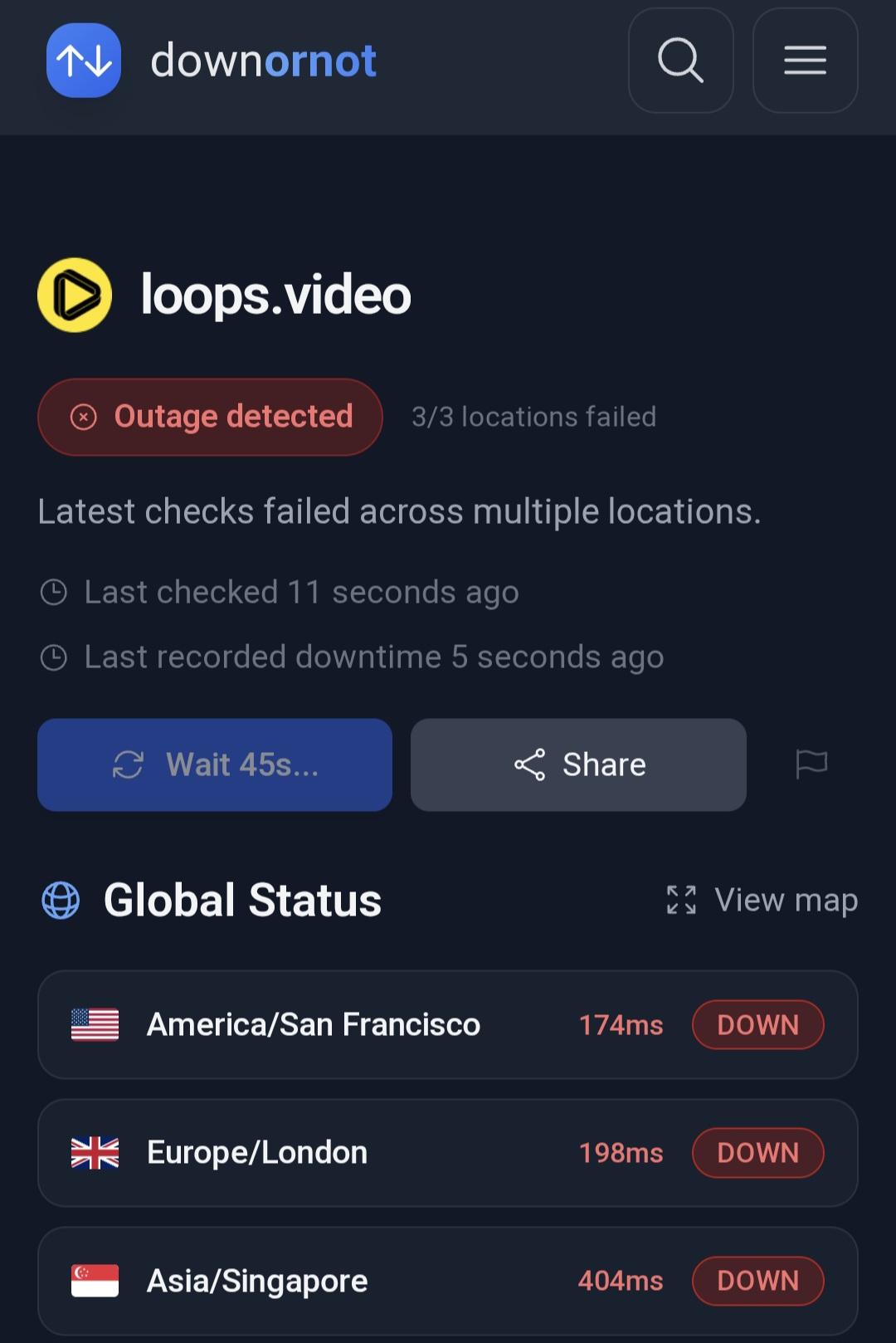
Alt...
Screenshot showing a server-side outage of Loops.video
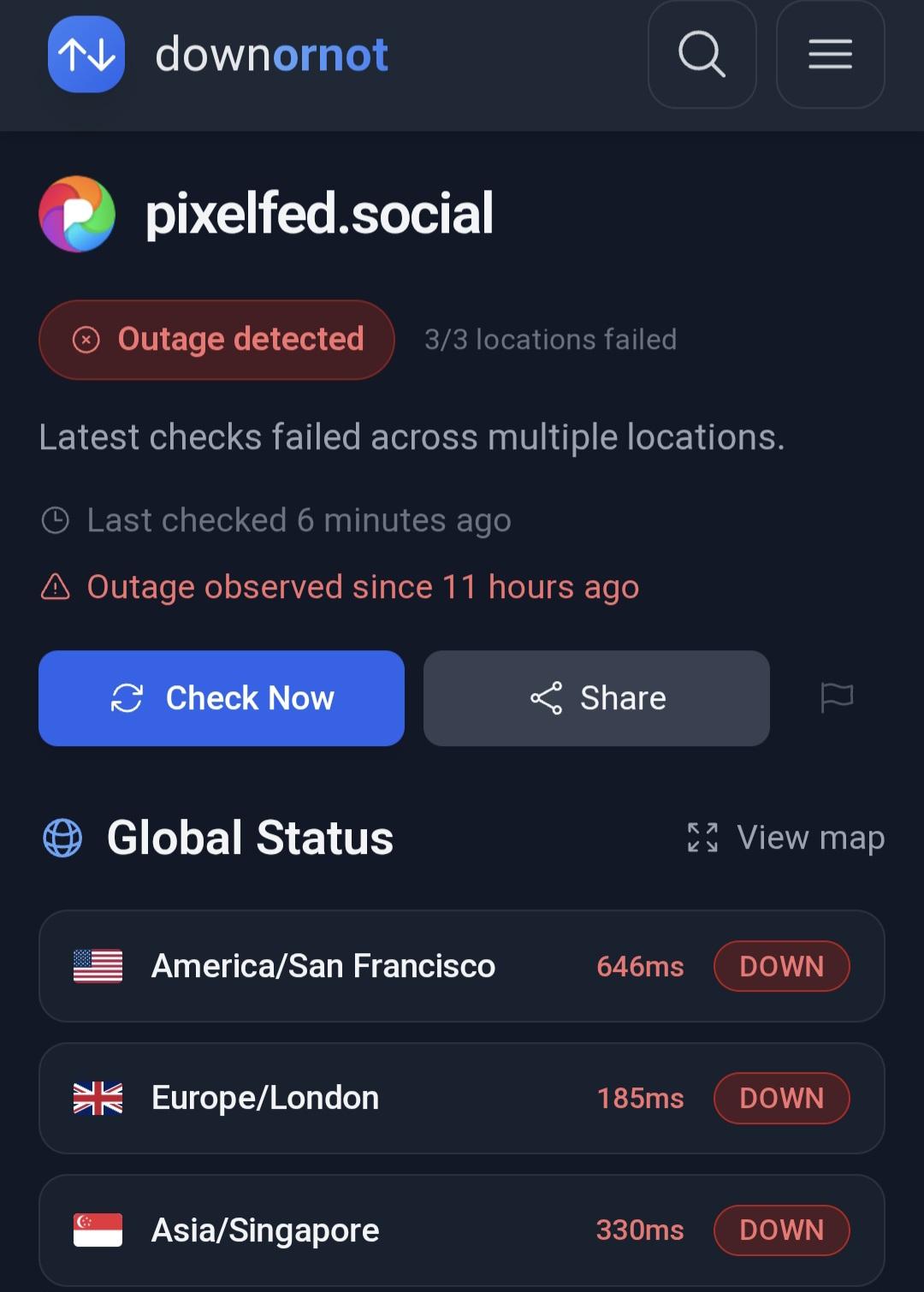
Alt...
Screenshot showing a server-side outage of PixelFed
🔬 The best bytes of #science & #tech across the #fediverse
“🌊 WATCH: Researchers from Universiti ⌗Malaysia Sabah teamed up with ⌗OceanX to study ⌗ocean waters down to 1,500 m․ Using submersibles, mapping tools, and environmental ⌗DNA sampling, the team is gather…”
https://fediscience.org/@tksst/117474447744302298
🤖 via RSS feed. Not an endorsement.
🔬 The best bytes of #science & #tech across the #fediverse
“Dutch National Cyber Security Center is Offline because it uses PHP
Link: ncsc․nl/actueel
Comments: news․ycombinator․com/item?id=50179828”
https://framapiaf.org/@newsycombinator/117479023298495539
🤖 via RSS feed. Not an endorsement.
🛡️ #Cybersecurity news & tips across the #fediverse
“Federal court rules OPM’s disclosure of millions of federal employee records to DOGE was unlawfulA New York federal court has ruled that the Office of Personnel Management (OPM) violated the Privacy Act when it granted …”
https://mastox.eu/@Sans_Google/117477511613916212
🤖 via RSS feed. Not an endorsement.
![[?]](https://m.dollha.us/system/accounts/avatars/115/674/140/997/782/850/original/9f75b7d632d219a8.jpg)
I've just learned that notifications can be filtered. I want to turn every single filter off. I don't like missing shit. How do I do this? Either I can't see it for looking, or Mastodon is a little obfuscated
![[?]](https://littlefedi.com/media/01a15537-c377-7717-9eee-93eb4922d508/image.jpg)
LittleFedi is up and running smoothly!
Email delivery is now configured and tested, and email is required for new registrations. Registration is open, so feel free to join us!
A big shout-out to @stefano@bsd.cafe for creating LittleFedi and making this project possible. 🙌 It's great to be able to run my own instance and contribute to the Fediverse in my own little way.
More to come!
#LittleFedi #Fediverse #OpenSource #SelfHosted #IndieWeb #SmallWeb #Developer
![[?]](https://thistlenfern.org/system/accounts/avatars/116/099/172/101/813/217/original/60cf938a1c1da64d.jpeg)
Monday I'm going to say out loud the thing I couldn't fit in 800 words this morning: that the 4:34 a.m. vote and the jobs report are not two stories. They're one story, and the timing of the first tells you exactly what they thought of the second.
#Fediverse #SelfHosted #Owncast #Journalism #IndieMedia #QueerNews #TransRights #USPolitics #Podcast #Livestream
1/2
![[?]](https://social.bund.de/system/accounts/avatars/115/226/279/652/288/347/original/e33ad57dd8ba39c3.png)
Das #Fediverse ohne #Bundesdigitalministerium? Undenkbar!
Warum es unserem Chef echt wichtig ist hier zu starten, erzählt er im Video.👇
#WirMachen #Digitalisierung und #Staatsmodernisierung und freuen uns auf den Austausch!
🛡️ #Cybersecurity news & tips across the #fediverse
“⌗Amazon delivery driver smart glasses will snap pictures of․․․ everything?
cnet․com/tech/amazon-delivery-driver-ai-smart-glasses-privacy/ ⌗ai ⌗surveillance ⌗SurveillanceCapitalism”
https://mastodon.sdf.org/@salixlucida/117477389641093462
🤖 via RSS feed. Not an endorsement.
🔬 The best bytes of #science & #tech across the #fediverse
“🤸♀️ TIL: Three dwarf reed snake ⌗species in Southeast Asia escape danger by curling into loops and cartwheeling away from predators․ Researchers recorded the acrobatic motion on a laboratory racetrack, finding tha…”
https://fediscience.org/@tksst/117474185032340367
🤖 via RSS feed. Not an endorsement.
🔆 #FediTips for https://PrivacySafe.Social & the #fediverse
“Okay, the sites are all updated behind the scenes and back online: fedi․tips, fedi․directory, fedi․garden and growyourown․services If they still look offline to you, that may be due to a cache somewhere which…”
https://social.growyourown.services/@FediTips/117480143606841731
🤖 via RSS feed. Your Mileage May Vary.
![[?]](https://s3.eu-central-2.wasabisys.com/mastodonworld/accounts/avatars/115/004/966/010/922/580/original/9c984c3da4f34c0b.jpg)
For Non Techies
 What is PHP and why did it take government websites offline?
#PHP #infosec #Fediverse #Computers
https://www.ctvnews.ca/sci-tech/article/what-is-php-and-why-did-it-take-government-websites-offline/
![[?]](https://files.mastodon.social/accounts/avatars/117/013/843/121/697/767/original/a8ae5fe2a8cca168.png)
Ich bin nicht aus Prinzip von Windows weg. Mein Wohnzimmer hieß Windows 11, und der Vermieter stellte dauernd Möbel rein, die ich nicht bestellt hatte: Copilot, OneDrive, Widgets, Bloatware. Also Pop!_OS auf eine zweite Platte, Dual Boot als Sicherheitsleine. Nach ein paar Wochen frage ich mich ernsthaft, wie ich Windows jahrelang ausgehalten habe. Welche Distro habt ihr – und warum? #Linux #OpenSource #Fediverse #Selfhosting
🔬 The best bytes of #science & #tech across the #fediverse
“To increase PHP representation in open source research, we encourage you to take the 2027 State of Open Source Survey․ Perforce, in collaboration with the Open Source Initiative and the Eclipse Foundation, have released…”
https://phpc.social/@thephpf/117474140569690102
🤖 via RSS feed. Not an endorsement.
🛡️ #Cybersecurity news & tips across the #fediverse
“📷 5 new license plate readers just reported around Dothan, AL․ Newly mapped by volunteers — see what's watching․ ⌗ALPR ⌗Surveillance ⌗Dothan ⌗Privacy ⌗FlockSafety deflocktheusa․com/flock-cameras/al…”
https://mastodon.social/@deflocktheusa/117476512045701895
🤖 via RSS feed. Not an endorsement.
![[?]](https://cdn.masto.host/iosdevspace/accounts/avatars/109/524/999/307/593/382/original/c6bd0b873cb33dd3.jpeg)
A new release of TootSDK - 23.7.0 📣
https://github.com/TootSDK/TootSDK/releases/tag/23.7.0
What's changed:
- Support Oauth web-based account creation flow @dale_price
Community contributions are greatly appreciated 🙌
![[?]](https://s3-eu-central-1.amazonaws.com/mastodon-aral/accounts/avatars/115/661/939/420/391/401/original/233bd09177532241.png)
Hey everyone,
@casey and @rania40 had the honour of speaking to one family from Gaza today and we’d like to welcome them to Gaza Verified.
They are:
• Kazem🍒in 🍒Gaza (@kazemabofares)
Please give them a warm welcome to Mastodon and to the fediverse, follow their account, and donate to their fundraiser if you can (and please share this so others can do the same).
Also, remember that you can find all our families who have fundraisers listed at the following page, ordered by those who have received the least in donations over the last week (on a rolling basis):
https://gaza-verified.org/donate/
Thank you for making Mastodon and the fediverse a safe space for our friends in Gaza and for your support.
💕
#Gaza #Palestine #GazaVerified #Mastodon #fediverse #newMembers #verification
Hey everyone,
@casey and @aseelfromgz had the honour of speaking to one family from Gaza today and we’d like to welcome them to Gaza Verified.
They are:
• Amir Gaza 🍉🇵🇸 (@AmirGaza)
Please give them a warm welcome to Mastodon and to the fediverse, follow their account, and donate to their fundraiser if you can (and please share this so others can do the same).
Also, remember that you can find all our families who have fundraisers listed at the following page, ordered by those who have received the least in donations over the last week (on a rolling basis):
https://gaza-verified.org/donate/
Thank you for making Mastodon and the fediverse a safe space for our friends in Gaza and for your support.
💕
#Gaza #Palestine #GazaVerified #Mastodon #fediverse #newMembers #verification
🔬 The best bytes of #science & #tech across the #fediverse
“The Future of CSS
Link: joshwcomeau․com/css/interop-2027/
Comments: news․ycombinator․com/item?id=50175070”
https://framapiaf.org/@newsycombinator/117476664008183414
🤖 via RSS feed. Not an endorsement.
🛡️ #Cybersecurity news & tips across the #fediverse
“Citizen Lab confirmed on 19 October 2026 that Serbian rector Vladan Đokić’s phone was infected with Pegasus․The attack used a zero-click exploit, meaning no action from the user was needed․Pegasus can give access to a d…”
https://mastodon.social/@hacksgr/117476009097617868
🤖 via RSS feed. Not an endorsement.
![[?]](https://freesewing-social.s3.de.io.cloud.ovh.net/accounts/avatars/115/311/482/808/831/682/original/73f558503dd5baa1.jpg)
💔 In Gaza, even vegetables have become a luxury.
Because the crossings are closed, markets are running out of fresh produce, and prices are soaring. A kilo of onions costs 15 shekels, while tomatoes and potatoes have reached 20 shekels per kilo.
I’m a mother of four, struggling to put food on my children’s table. 💔 How can I feed them when even the simplest food is becoming unaffordable?
https://gofund.me/4d998a9f7
#Palestine #Fediverse #fediforgaza
@mutualaidspace

![[?]](data:image/png;base64, iVBORw0KGgoAAAANSUhEUgAAAEAAAABAAQAAAACCEkxzAAAAV0lEQVQoz43RwQ3AMAwCQDZg/y3ZgNqo3+JaedwDOUQBQFHYaTB8wTM6sGl2cMPu+DFzn+ZcgN7wF7ZVihXkfSlWIVzIA6dbQzaygllpNuTXZmmFNlvxADX1+o0cUPMbAAAAAElFTkSuQmCC)
Well, I did it — I made my first game! Highball Express: you're the conductor of a cross-country passenger train on the Liberty Line. Departure checks, blizzards and breakdowns, unruly passengers — and it plays entirely by sound. It's a test version headed for a real app someday; feedback welcome on what was fun, what confused you, and what broke. (In railroad talk a "highball" is the signal for clear track ahead — full speed ahead. Not about drinks.)
https://audiogamer85.itch.io/highball-express
#accessibility #gaming #ai #blind #visuallyimpaired #accessiblegaming #fediverse
![[?]](https://media.infosec.exchange/infosec.exchange/accounts/avatars/117/429/778/072/387/198/original/ae77e23ee6d04fa3.png)
Here is another reason I've joined Infosec.Exchange:
I like to use rich text formatting and I cannot lie.
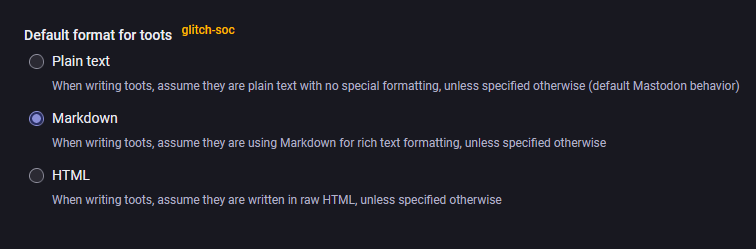
Alt...
This is a Glitch server, which means you can use Plain Text, Markdown or HTML text formatting.
![[?]](https://hj.9fs.net/p/s/avatar-dea0df353fcc369128b6bd7ae161bec5.jpg) p » 🌐
p » 🌐
@p@hj.9fs.net
Please leave a comment if you like it! Thanks!
🛡️ #Cybersecurity news & tips across the #fediverse
“'Court records show the ⌗DHS ofcs🚨who tried to search the man who wiped his GrapheneOS phone LIED․ They pushed him about having child abuse images․ Docs reveal that was a pretext;🚨he wasn't suspected of this at al…”
https://toad.social/@KimPerales/117475404035473367
🤖 via RSS feed. Not an endorsement.
🔬 The best bytes of #science & #tech across the #fediverse
“New ⌗Paper published in Quantum: Asymptotically good bosonic Fock state codes quantum-journal․org/papers/q-2026-10-20-2240/ ⌗OpenScience ⌗Quantum ⌗Research”
https://mathstodon.xyz/@quantumjournal/117473611843525070
🤖 via RSS feed. Not an endorsement.
![[?]](https://hameln.social/system/accounts/avatars/110/010/089/354/459/142/original/b932665f7b6ceea7.jpeg)
RE: https://hameln.social/@hamelnerbote/117478293496845208
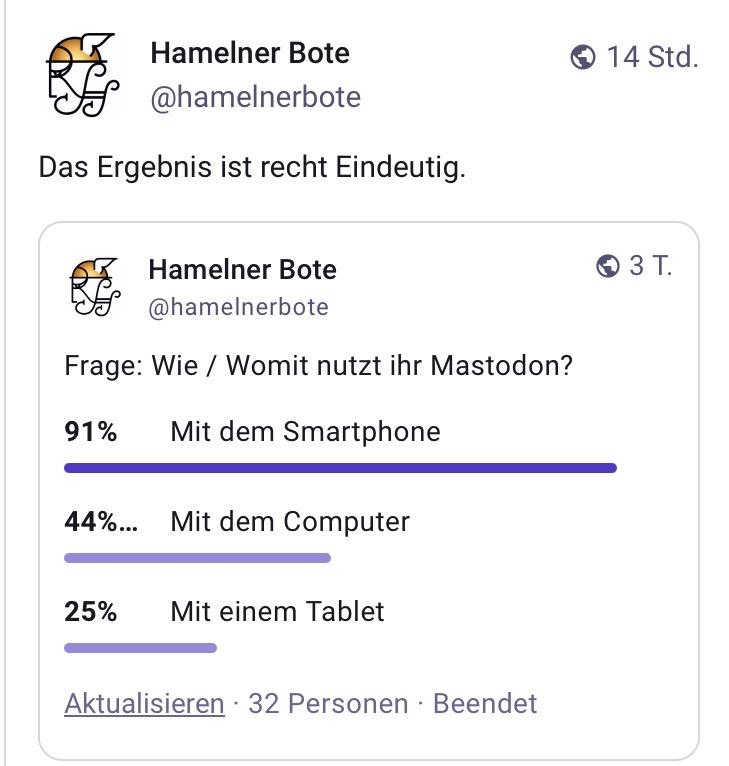
Für mich wäre die Folgerung eher: Bilder sollten auch auf kleinen Bildschirmen gut erkennbar sein. „Nur Hochformat“ und „keine Collagen“ wäre mir zu pauschal. Eine Collage aus zwei Bildern ist etwas anderes als eine aus zwölf. Und ein Querformat kann zum Motiv passen.
Die Umfrage zeigt, welche Geräte genutzt werden – ob Hochformat oder Einzelbilder bevorzugt werden, müsste man gesondert fragen. 🙂
Für mehr Sichtbarkeit würde ich außerdem passende Hashtags nutzen, denen andere folgen können, und Beiträge öffentlich posten. Für bessere Zugänglichkeit: Bildbeschreibungen ergänzen, auf ausreichend große Schrift und gute Kontraste achten und wichtige Aussagen auch in den Beitragstext schreiben.
Und wir können selbst zur Verbreitung beitragen: Gute Beiträge boosten und miteinander ins Gespräch kommen.
#botenreform #Mastodon #Fediverse #Barrierefreiheit #AltText #reichweite
Eine Folgerung aus diesem Umfrageergebnis könnte sein:
A) Bilder nur noch im Hochformat
B) Keine Bildcollagen mehr.
Beides würde die Ansicht auf dem Smartphone erleichtern.
🤔 Meinungen dazu?
#botenreform
Alt...
Umfrageergebnis
![[?]](https://hameln.social/system/accounts/avatars/108/256/753/578/809/495/original/1df912d8122fc0b5.jpg)
🔬 The best bytes of #science & #tech across the #fediverse
“New ⌗Paper published in Quantum: Interactive proofs for verifying (quantum) learning and testing quantum-journal․org/papers/q-2026-10-20-2239/ ⌗OpenScience ⌗Quantum ⌗Research”
https://mathstodon.xyz/@quantumjournal/117473535650915199
🤖 via RSS feed. Not an endorsement.
🛡️ #Cybersecurity news & tips across the #fediverse
“Americans, this is your chance to slap down the tech broligarchs
By Rebecca SolnitThe midterms will be a referendum on the GOP’s alignment with tech overlords over the public they’re meant to serve theguardian․com/glob…”
https://rssfeed.media/@guardianfeeds/117474853096087216
🤖 via RSS feed. Not an endorsement.
9 000+ установок в Google Play. До отметки 50 000 осталось всего 1000 🚀
Сообщество vir.group растёт, и нам приятно видеть, что всё больше людей находит нашу платформу и становится частью экосистемы для предпринимателей, инноваторов и амбициозных идей.
Следующая цель: 50 000 установок в Google Play.
Мы делаем не просто приложение. Мы создаём возможности для людей, чтобы они могли знакомиться, сотрудничать и воплощать свои идеи в жизнь.
Если вы предприниматель, основатель или инвестор и ищете новые возможности, давайте знакомиться. Помогите нам дойти до следующей отметки и стать частью этого пути 🤝
vir.group
#virgroup #Startup #Entrepreneurship #Investment #Innovation #TechStartup #Founders #Investors #Fediverse #50KMilestone

#ADELAJAs-SUBJECT INDEXES- "BAPHOMET'S ENCYCLOPEDIA-THE GREAT & COSMIC GAME
https://gettr.com/post/p44q8nh7ed2
#ADELAJsCATALOGUEsCOSMIcGAME
gabUPDATESaccess
veroTABLEBASEaccess
https://vero.co/firstcivilization/1B6q-PS6Zsk2PRrZ4Xm5t7d1
---
ARCHETYPES
'THE BLACK CROWNED PAWN'
https://vero.co/firstcivilization/1B6q-PS6Zsk2PRrZ4Xm5t7d1
ADELAJAs THeGREAT & COSMIcGAME
https://metaquanalanics.wixsite.com/book-in/the-great-game
... is a modern, PSYCHOLOGICAL, ANALYTICAL TOOL..
Copyright 2026 Oladipo Adegboyega Adelaja All rights reserved
🛡️ #Cybersecurity news & tips across the #fediverse
“An AI Agent Joined a Listserv of Top Internet Researchers․ The Reply-All Chaos Is Still UnfoldingOn Thursday morning, as the Association of Internet Researchers (AoIR) began the second day of its annual conference…
⌗N…”
https://newsbeep.org/@us/117474775635350132
🤖 via RSS feed. Not an endorsement.
🔬 The best bytes of #science & #tech across the #fediverse
“Ofcom Concedes Defeat in the 4chan Case
Link: prestonbyrne․com/2026/10/20/ofcom-concedes-defeat/
Comments: news․ycombinator․com/item?id=50167028”
https://framapiaf.org/@newsycombinator/117474068800643483
🤖 via RSS feed. Not an endorsement.
🔬 The best bytes of #science & #tech across the #fediverse
“New ⌗Paper published in Quantum: Reliable Entropy Estimation from Observed Statistics for Device-Independent Quantum Cryptography quantum-journal․org/papers/q-2026-10-20-2238/ ⌗OpenScience ⌗Quantum ⌗Res…”
https://mathstodon.xyz/@quantumjournal/117473410991270846
🤖 via RSS feed. Not an endorsement.
![[?]](https://dmesg.online/fileserver/01DM9YWCYF6MVFMF2A6P0QBT12/attachment/original/01M4C2BZZJY1XT9F2M9K7DY1ZK.jpeg)
fedtail 0.17.1: как это было
Помните, как сидели в аське? Справа узкий ростер с группами «▾ Друзья (2/15)», цветочки, двойной клик, и открывается окно с вкладками. Наверху «Ник (15:25:43 23/06/2007)» красным и синим, внизу строка ввода с мордой собеседника. А рядом Агент с оранжевыми глянцевыми кнопками.
Не скажу, что там. Просто запустите
python3 fedtail --layout split --theme qip-modern
и приготовьте олдскулы, по ним сейчас прилетит.
Если мало, есть ещё qip-retro (QIP под XP, бежевый), mra, mra-blue, mra-green, mra-violet (все скины Агента) и psi (Psi+, со своими родными значками).
![[?]](https://cdn.masto.host/musiciansocial/accounts/avatars/111/454/875/201/515/175/original/0790633e75ea218a.png)
New on our blog: The Trouble With Post Tracks by Mirlo
https://mirlo.space/team/posts/800
Support Mirlo: https://mirlo.space/team/tip ❤️🐦⬛
#Music #Mirlo #Blog #Blogs #MusicNews #FediMusic #Fediverse #Musicians
🔬 The best bytes of #science & #tech across the #fediverse
“Demographic 'Doomsday' Misses the Mark science․org/doi/10․1126/science․ael8752 Comments: news․ycombinator․com/item?id=50165276 ⌗HackerNews ⌗Demographics ⌗Doomsday ⌗Misses ⌗the ⌗Mark ⌗Scien…”
https://mastodon.social/@h4ckernews/117473249242827483
🤖 via RSS feed. Not an endorsement.
🛡️ #Cybersecurity news & tips across the #fediverse
“'LIVE NOW: David Sirota and ⌗LindsayOwens Discuss ⌗Midterms, ⌗Surveillance Pricing, and More' youtube․com/watch?v=U_ZEZzfeHmc ⌗TheLever ⌗DavidSirota”
https://mastodon.social/@MindTGap/117474460982410838
🤖 via RSS feed. Not an endorsement.
🔆 #FediTips for https://PrivacySafe.Social & the #fediverse
“I have put my websites including fedi․tips, fedi․directory, fedi․garden and growyourown․services into maintenance mode while waiting for some important technical updates behind the scenes․The updates are due today, so h…”
https://social.growyourown.services/@FediTips/117477518374489107
🤖 via RSS feed. Your Mileage May Vary.
![[?]](https://media.beige.party/accounts/avatars/117/126/273/130/135/635/original/e4c8be19fbce5e49.png)

GOOD NEWS, EVERYONE!
I am thrilled to announce that I have successfully converted someone from the meatspace to the quiet pastures of beige.party and the #Fediverse!
She's one of my dearest friends of over *cough* thirty *cough* years, and one of the wisest and also hilarious people I've ever known.
Please give a warm weirdo welcome to @dopaminehouse!!
Welcome, my friend! I adore this community and am excited to share it with you.
![[?]](https://media-fedi.lulebay.com/accounts/avatars/117/450/186/756/832/017/original/a59d350447ff6148.png)
Itu orang-orang pada komplain kena ban atau kena take down postingannya gara-gara bahas #karhutla di #sosmed mainstream. Pada belum kenalan sama #fediverse sepertinya mereka.
![[?]](https://friendica.world/photo/profile/milanjhudiel.jpeg?ts=1784597700)
Digital Exodus: Why I Left the Algorithmic Mall Behind
For years, major social media platforms promised a simple space to share moments, connect with people, and build communities. But over time, what started as a creative outlet transformed into something entirely different: an aggressive, ad-driven marketplace engineered to commodify attention, standardize bodies, and monetize human insecurity.
When platforms prioritize corporate profit and algorithmic engagement over user well-being, they stop being tools for communication and start operating like digital shopping malls. Constant ads, toxic comparison loops, and data harvesting have made the mainstream web exhausting.
That is why moving to decentralized, open networks like the Fediverse isn't just an alternative—it’s a necessary liberation.
Using ad-free, independent spaces like Pixelfed and Friendica gives us back control over our digital footprint. No corporate overlords, no invasive trackers, no manufactured outrage, and zero algorithms deciding what we deserve to see.
True connection doesn't need a middleman, and it certainly doesn't need an ad budget. Here’s to building a cleaner, freer, and more human web.
#Fediverse #Privacy #Decentralization #Pixelfed #Friendica #DigitalMinimalism
![[?]](https://f.termine.di.day/media/ea30627fa6dc1bc541640329a2dae7d47fe8edec2ccf05a5d8f9e087abb18a2a.png?name=event_image.png)
Digitaler Unabhängigkeitstag in den Acme Labs Bielefeld: Mit Kind und Kürbis!
1. November 2026, 14:00:00 CET - GMT+1 - Mühlenstraße 5, 33607 Bielefeld, North Rhine-Westphalia, 5 Mühlenstraße (Bielefeld) [SENSITIVE CONTENT]
Die vergangenen Digitalen Unabhängigkeitstage haben unsere Besucher:innen genutzt, um von Windows oder macOS auf GNU/Linux umzusteigen. Oder um ihre Backups zu automatisieren. Andere sind erst mal nur von Microsoft Office auf LibreOffice umgestiegen, haben die Suchmaschine gewechselt oder einen Werbeblocker installiert oder ihr Smartphone sicherer gemacht. Oder sie probieren Mastodon aus, weil sie selbstbestimmt kommunizieren wollen, statt von Musk oder Meta monetarisiert zu werden.
Bei all diesen Veränderungen treten Fragen auf, die ihr den Datenpunks und anderen Helfenden an diesem Tag stellen könnt. Bringt gern eure Geräte mit, und wir schauen gemeinsam drauf.
Eintritt frei. Wer demokratiefeindlichen Organisationen anhängt, ist bei unseren Veranstaltungen nicht erwünscht.

Location: Mühlenstraße 5, 33607 Bielefeld, North Rhine-Westphalia
Time: 2026-11-01 14:00:00 / 17:00:00 (Europe/Berlin)
🔬 The best bytes of #science & #tech across the #fediverse
“💡 Post-publication review as a digital colloquium - a new blog post by ﹫adrienfillon Adrien Fillon writes:
🔹 'Post-publication review aims to collectively reflect on what has been published, in order to inform oth…”
https://scicomm.xyz/@ReproducibiliTeaGlobal/117473102508018747
🤖 via RSS feed. Not an endorsement.
🛡️ #Cybersecurity news & tips across the #fediverse
“flocksurveillance․org/ location data culled from Flock’s own records in December of 2025, in addition to acoustic detection devices and third-party cameras․ ⌗flocksurveillancemap ⌗flocksafety ⌗alpr ⌗survei…”
https://mastodon.social/@gtbarry/117474149322480851
🤖 via RSS feed. Not an endorsement.
![[?]](https://s3.blueplanet.social/accounts/avatars/114/448/850/197/133/346/original/d17b2b69b0eb314d.png)
Bekommt ihr auch seit einigen Tagen Nachrichten ohne Inhalt aber mit vielen Adressen?
#fediverse #Mastodon
🛡️ #Cybersecurity news & tips across the #fediverse
“In yet another reason you should ⌗DeleteMeta > Meta Muse exposes users' personal and business secrets when they share conversations arstechnica․com/security/2026/10/meta-muse-exposes-users-personal-and-business-se…”
https://boriken.social/@bloodravenlib/117474042791502167
🤖 via RSS feed. Not an endorsement.
🔬 The best bytes of #science & #tech across the #fediverse
“Public talk by Alessandra BuonannoOn 2 November, Alessandra Buonanno, director at ﹫mpi_grav in Potsdam, will give a public talk at the event 'Einstein Telescope: Europas Blick in die Zukunft' as part of Berlin …”
https://academiccloud.social/@mpi_grav/117472838076055547
🤖 via RSS feed. Not an endorsement.
🔬 The best bytes of #science & #tech across the #fediverse
“Tsrs: A Port of TypeScript to Rust
Link: blog․cloudflare․com/typescript-rust-port/
Comments: news․ycombinator․com/item?id=50165953”
https://framapiaf.org/@newsycombinator/117473832782784931
🤖 via RSS feed. Not an endorsement.
🔬 The best bytes of #science & #tech across the #fediverse
“Inside PH4NTXM: ⌗57 PH4NTXM Session GuardYour session identity should stay consistent throughout your session․Session Guard checks generated identity consistency and protection readiness every 10 seconds․ If it detects …”
https://defcon.social/@PH4NTXMOFFICIAL/117472472466275138
🤖 via RSS feed. Not an endorsement.
🛡️ #Cybersecurity news & tips across the #fediverse
“Why are Houston police the top searchers of the University of North Carolina's Flock network?Houston police are the number one searchers of a Flock camera network more than a thousand miles away at the University of ⌗…”
https://mastodon.social/@gtbarry/117473841623507860
🤖 via RSS feed. Not an endorsement.
Adding another #sketching / #drawing to #fediverse and #inktober

Alt...
An abstract black and white drawing featuring intersecting lines and geometric shapes. The composition creates varied line thickness and patterns.
Thursday the flyer-mill gets the long version, live on a server I run myself — nobody's plug to pull. Iowa's mailers or Nebraska's fine print:
Where do I start?
https://live.thistleandmoss.org Fuck Trump
#Trans #Politics #Fediverse #Vote #Owncast #Fediverse #IndieMedia #QueerMedia

Alt...
Donald Trump stands on stage giving a thumbs-up, wearing a dark suit and red tie against a blue and red background. Large text at the bottom reads, “I’M DONALD TRUMP AND I APPROVE THIS MESSAGE,” with a small “imgflip.com” watermark in the lower left.
🔬 The best bytes of #science & #tech across the #fediverse
“A Scientist Tattooed Himself With Invisible Ink That Only Appears Under UV Light
popsci․com/science/disappearing-tattoo-ink/
A researcher has tattooed himself with a UV-activated dye that remains invisible under nor…”
https://flipboard.social/@fediboard_science/117472307937479784
🤖 via RSS feed. Not an endorsement.
🛡️ #Cybersecurity news & tips across the #fediverse
“The ⌗MapQuest Renaissance Continues as the Platform Adds ⌗Flock Camera Locations gizmodo․com/the-mapquest-renaissance-continues-as-the-platform-adds-flock-camera-locations-2000827015 ⌗privacy ⌗maps ⌗…”
https://mastodon.thenewoil.org/@thenewoil/117473830819206292
🤖 via RSS feed. Not an endorsement.
🔆 #FediTips for https://PrivacySafe.Social & the #fediverse
“p․s․ You can read the Mastodon developers' official blog post about Mastodon 5․0 at blog․joinmastodon․org/2026/10/5․0-a-closer-look p․p․s․ This doesn't affect app store apps directly, they have separate developers․ T…”
https://social.growyourown.services/@FediTips/117474236760119858
🤖 via RSS feed. Your Mileage May Vary.
![[?]](https://s3.eu-central-2.wasabisys.com/mastodonworld/accounts/avatars/109/372/395/239/012/417/original/eb63a8e81d8cf6f4.jpg)
Buenas tardes, solo aviso por si les pudiera ser de interés, que ayer agregue un nuevo episodio en mi podcast #enterate #mastodon #fediverso #fediverse desde #ElSalvador https://www.spreaker.com/episode/episodio-33-noctambulo-escritor-sv-delirios-dictatoriales--75867642 #noticia #latinamerica #LATAM #ultimahora escuchenlo cuando tengan alguna ocasión oportuna y #compartir a otros #salvadoreñosporelmundo @elfaronet @revistafactum @laprensagrafica @gatoencerradosv @radioysuca @arpas_elsalvador @izcanal_rtv @iHeartRadio #spanish #enespañol
![[?]](https://assets.chaos.social/accounts/avatars/000/082/859/original/2c8e2458753c695b.jpeg)
App update: Scatto for Pixelfed (iOS)
- App icon matches you preferred color-scheme
- Fixes: smooth scolling thru timeline, jumping in timeline when coming bacl, app-badges clearing faster
https://apps.apple.com/de/app/scatto-for-pixelfed/id6796387680

🔬 The best bytes of #science & #tech across the #fediverse
“europesays․com/3321337/ AI-powered virtual reality could help women manage menopause symptoms ⌗AI ⌗ArtificialIntelligence ⌗CognitiveBehavioralTherapy ⌗depression ⌗healthcare ⌗hormone ⌗insomni…”
https://pubeurope.com/@europesays/117472033911820945
🤖 via RSS feed. Not an endorsement.
🔬 The best bytes of #science & #tech across the #fediverse
“DeepSeek just open-sourced its inference engine
Link: github․com/deepseek-ai/DeepInfer
Comments: news․ycombinator․com/item?id=50163277”
https://framapiaf.org/@newsycombinator/117472653123586290
🤖 via RSS feed. Not an endorsement.
🛡️ #Cybersecurity news & tips across the #fediverse
“Officers Charged Over Flock Camera Misuse: Why It Matters ⌗ALPR ⌗Surveillance ⌗Privacy ⌗FlockSafety deflocktheusa․com/officers-charged-over-flock-camera-misuse-why-it-matters/”
https://mastodon.social/@deflocktheusa/117473556236293493
🤖 via RSS feed. Not an endorsement.
🔬 The best bytes of #science & #tech across the #fediverse
“Table Mountain Radio Quiet Zone - In Place Since 1954 In Colorado - Is ‘Suddenly In The Media’ | Colorado Cell Complaints Pile Up As Table Mountain Radio Quiet Zone Limits Squeeze AT&T, Verizon And T-Mobile
--
its․nti…”
https://techhub.social/@GregCocks/117470972569930953
🤖 via RSS feed. Not an endorsement.
🛡️ #Cybersecurity news & tips across the #fediverse
“Oak Brook Police Defend Flock Cameras After Mall Incident ⌗ALPR ⌗Surveillance ⌗Privacy ⌗FlockSafety deflocktheusa․com/oak-brook-police-defend-flock-cameras-after-mall-incident/”
https://mastodon.social/@deflocktheusa/117473556116497123
🤖 via RSS feed. Not an endorsement.
🔆 #FediTips for https://PrivacySafe.Social & the #fediverse
“Some servers are now running the experimental version of Mastodon 5․0 on their websites․ This overhauls the web interface and has moved and renamed some things (for example 'Lists' are now called 'Feeds')․The developers…”
https://social.growyourown.services/@FediTips/117474206171253879
🤖 via RSS feed. Your Mileage May Vary.
I am Palestinian from Gaza. This is my land. 🇵🇸
I am not an aggressor—I am simply trying to survive.
💔 If you see this, please leave a comment and, if possible, make a small donation. Your support could help my family survive. 🙏🇵🇸
https://gofund.me/4d998a9f7
#Palestine #Fediverse
#fediforgaza #gaza_help @fabio
@amber
@YouShallNotPass
@johnwise @edendestroyer @Persona
@rysiek
@inquiline @Nigel_Purchase
@sinmisterios

Alt...
am Palestinian from Gaza. This is my land. 🇵🇸
I am not an aggressor—I am simply trying to survive.
💔 If you see this, please leave a comment and, if possible, make a small donation. Your support could help my family survive. 🙏🇵🇸
#Fedle has passed 20k games played on the #Fediverse.
Feel free to join this daily Wordle game, available in 5 languages: English, French, German, Spanish and Italian.
Help your instance reach the top of the leaderboard.
https://fedle.fedilab.app/leaderboard
More about how it works: https://fedle.fedilab.app/about
Praise be to Glitch. Here's the Mastodon.social future 5.0 no one asked for.
#Fediverse #Mastodon #GlitchRules #lol #wtf
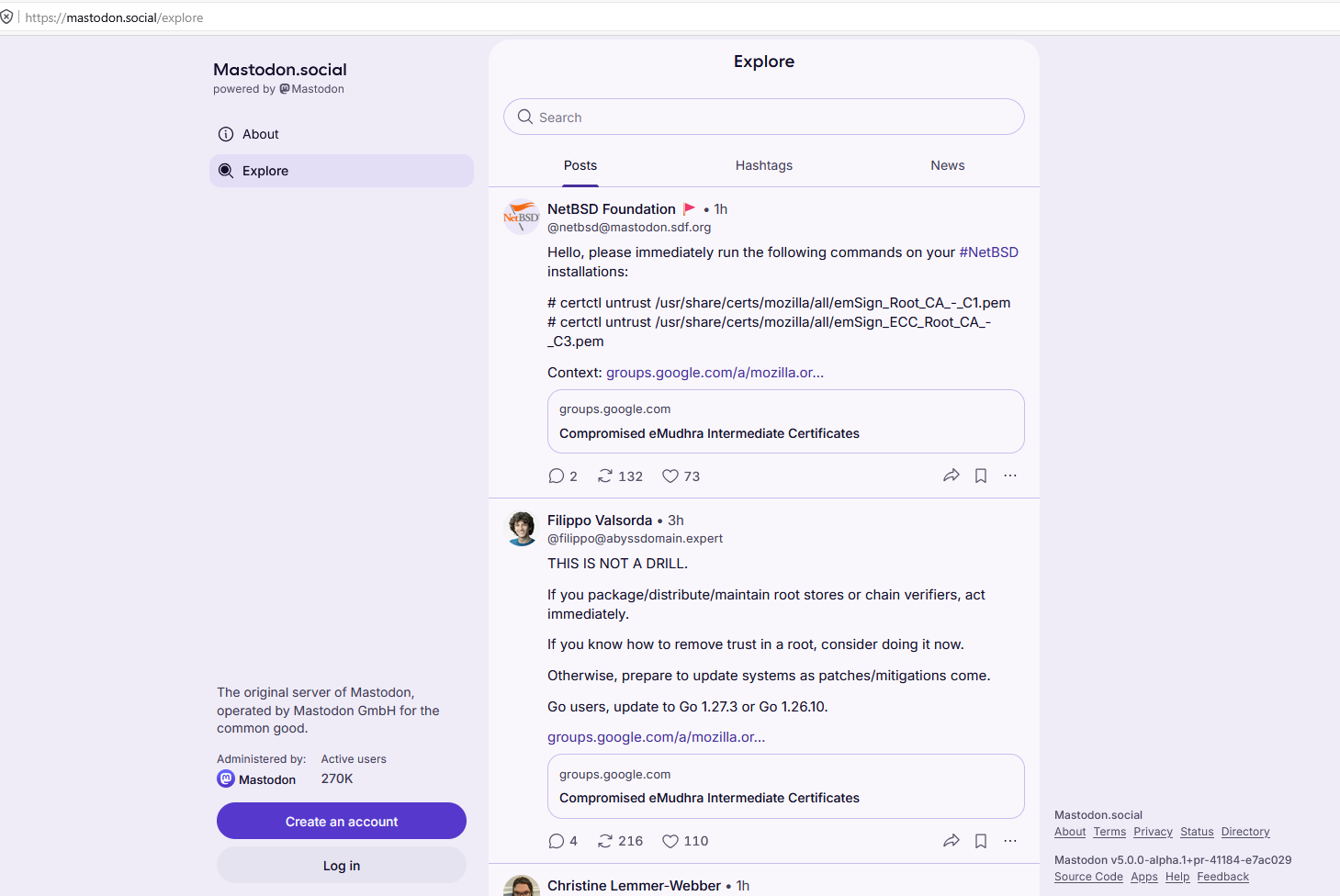
Alt...
New Mastodon about page ui appears to have no operabilty anymore.
🔬 The best bytes of #science & #tech across the #fediverse
“Well, a cup of hot coffee ☕ and Leonard Cohen's baritone voice 🎵🎵 ⌗life ⌗coffee ⌗music ⌗linux ⌗research”
https://mastodon.social/@unixbhaskar/117469592416575590
🤖 via RSS feed. Not an endorsement.
🛡️ #Cybersecurity news & tips across the #fediverse
“People are using ⌗AI to make their ⌗smartTV dumb again
One solution, called 'dumbtv,' describes its mission on GitHub thus: 'Your TV should do what you paid for: your apps, your HDMI inputs, and nothing else․ No…”
https://hachyderm.io/@BenjaminHCCarr/117472666662144760
🤖 via RSS feed. Not an endorsement.
We are open source, cooperatively-run, community-led and in the process of joining the social web. We're also working collaboratively with others in the space towards different modes of decentralisation, going against enshittification and one-size-fits-all approaches.
If you'd like to support our work and help allocate more resources towards these things, there are several ways to do so at the link below. Thank you! 💪🐦⬛
![[?]](https://media.norden.social/accounts/avatars/113/834/222/440/406/289/original/02ad5384b08028cb.png)
🍻🥤 Das nächste Kneipentreffen der #Datenpunks #Bremen ist am Donnerstag 5.11. 19:00 im Lagerhaus Kafé, Schildstr. 12-19
Wenn Du Lust hast uns kennen zu lernen oder über alternative Social Media Angebote im #Fediverse, Verschlüsselte #Messenger, datenschutzfreundliche Apps oder #Linux quatschen möchtest, komm gern vorbei. Wir freuen uns auf Austausch.
Es gibt keine Agenda, kein Protokoll, einfach nur entspannt Zeit miteinander verbringen. #Datenschutz #SocialMedia
![[?]](https://cdn.fosstodon.org/accounts/avatars/108/998/922/888/845/166/original/4bb3b0980c8fe06a.png)
ICYMI: Learn how the Fediverse was built in the latest article from our series on public funding of open source
@nlnet @NGIZero @cwebber @Bonfire
#DigitalAutonomy #ActivityPub #Fediverse #OpenSource #community #FOSS

Alt...
© artemisdian, 123RF.com
Someone's already bitching and moaning that the prototypical new interface design that hasn't been rolled out yet is making it impossible for them to use Mastodon. Never change, people with imaginary bellyachings.
![[?]](https://media-proxy.berlin.social/accounts/avatars/112/398/064/483/496/914/original/7c883b373317a7ad.png)
🚨 #Meta schaltet #NoKings genau dann stumm, als Amerikaner:innen gegen Trump auf die Straße gehen.
Ein „automatisierter Fehler“, heißt es. Schon seltsam, wie oft die #Demokratie im #Algorithmus hängen bleibt. 🤔✊
Frag nicht um Erlaubnis. Schaff dir deinen eigenen Raum. Behalte deine Stimme. Just #Fediverse. 🌍🦣💥
🚀🎉 Successfully registered at #40C3: the #FediverseAssembly! 🐘🌐
As part of the #cbase Habitat, we’re bringing the Fediverse to Hamburg! ⚓💜
💡 Submit workshops 🤝 Organise meet-ups 🌍 Connect, collaborate & share ideas
📣 Got an idea? Submit your workshops, meet-ups and networking sessions for the Fediverse Assembly ASAP!
See you in Hamburg! 🏴☠️✨
#Fediverse
- - -
🚀🎉 Erfolgreich registriert auf dem #40C3: Die #FediverseAssembly! 🐘🌐